What July's CPI Report Means for Stocks, Sectors, and the Fed, Explained Simply
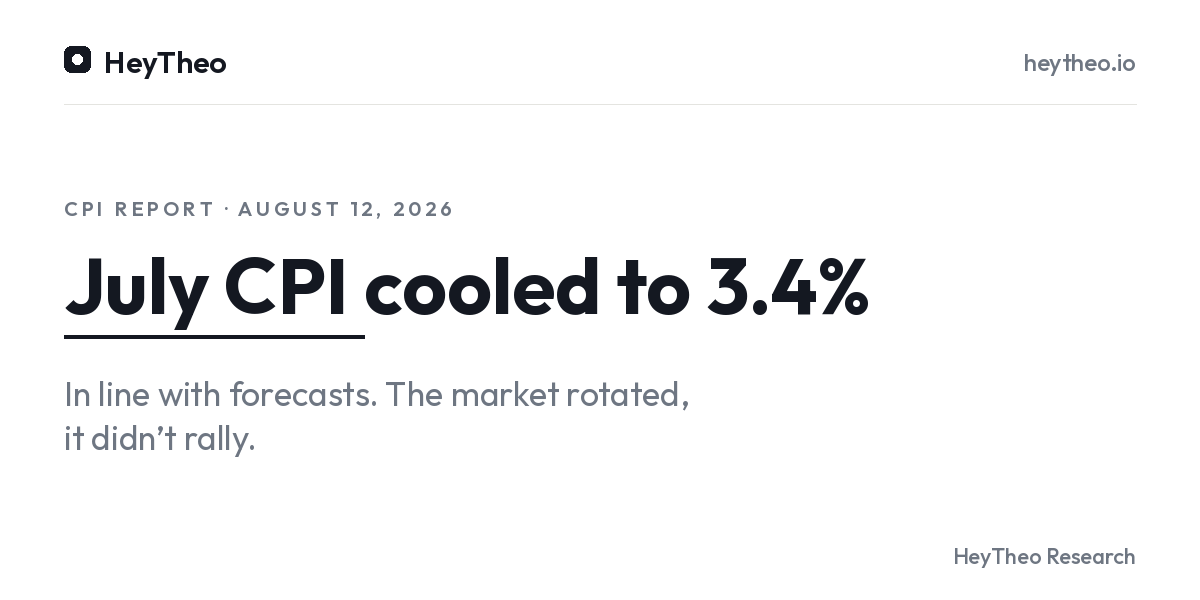
July CPI matched forecasts at 3.4%, core 2.5%. Stocks barely moved as money rotated into chips, and the Fed's September choice became hold or hike.
Inflation landed exactly where the Street expected: 3.4%. The real story was underneath — money rotated into chips while megacap platforms sold off, and the Fed's September call is now hold-versus-hike, not cut.
HeyTheo Research — August 12, 2026
The Quick Read
July CPI rose 0.1% for the month and 3.4% over the year, with core at 2.5% — both in line with forecasts and both a tenth lower than June. The cooler print eased pressure on the Fed to raise rates in September, but the index barely moved: the S&P 500 added about 0.3% while money rotated into semiconductors and AI infrastructure and away from some megacap platforms. On the rules HeyTheo tracks, that split — a quiet index masking a loud sector rotation — is the part worth watching.
July's inflation report told the Fed roughly what it wanted to hear and told the stock market almost nothing new — which is why the action moved under the surface, into sectors, instead of lifting everything at once.
The number: inflation cooled, but only a little
The Consumer Price Index rose 0.1% in July and 3.4% over the past 12 months, down from 3.5% in June. Core CPI — which strips out food and energy — rose 0.2% on the month and 2.5% on the year, a tenth cooler than June. Both figures matched what economists surveyed by Dow Jones had penciled in, so there was no surprise for the market to reprice around.
Shelter did most of the work. It rose just 0.1% but, because it's the biggest single piece of the basket, it accounted for roughly two-thirds of the entire monthly increase. Energy fell 1.5% on the month, with gasoline down 2.9%, which is what kept the headline so soft. The catch: energy is still up 14.7% over the past year, and gasoline is up 24.6% — a reminder of how far prices climbed before this year's cooling.
Component | July (monthly, seasonally adjusted) | Past 12 months |
|---|---|---|
All items (headline) | +0.1% | +3.4% |
Core (less food & energy) | +0.2% | +2.5% |
Shelter | +0.1% | +3.2% |
Energy | −1.5% | +14.7% |
Gasoline (all types) | −2.9% | +24.6% |
Food | +0.1% | +3.0% |
Airline fares | +2.2% | +25.5% |
Source: U.S. Bureau of Labor Statistics, CPI-U, July 2026 release (August 12, 2026).

One clean number to hold onto: airline fares jumped 2.2% in July and are up 25.5% over the year — the single largest 12-month move in the core report.
Why it matters beyond one data point: the Fed's September call
This is not a "will they cut 25 or 50" story. The live debate right now is whether the Fed holds rates steady or raises them at its September meeting — three policymakers dissented at the July meeting in favor of a hike, so the hawkish case is real, not hypothetical.
After the print, futures markets nudged away from that hike. CME FedWatch odds of a September increase fell to around 42%, down from roughly 50% before the report, and traders tilted toward the Fed simply holding. As Bill Adams, chief U.S. economist at Fifth Third Commercial Bank, put it, the report narrowly meets the bar to keep the Fed on hold.
The backdrop is what makes it a genuine coin-flip. The July jobs report showed the economy shed 23,000 jobs — soft enough to argue for patience — while oil pushed toward $90 a barrel on Strait of Hormuz tensions, which pulls the other way on inflation. Cooling prices, a cooling labor market, and a rising oil wildcard don't point cleanly in one direction. HeyTheo's news scan flags moves like this with the source attached, so you can see the data behind the headline rather than the headline alone.

Where the money actually went: a rotation, not a rally
Here's the tell. The S&P 500 rose about 0.3% and the Dow sat near flat, but the Nasdaq Composite added 0.6% — and underneath, the split was stark. The sharp buying went into semiconductors and AI infrastructure: NVIDIA rose 2.7% to about $223, CoreWeave jumped roughly 18%, and Nebius climbed 16.5% on strong results, while several megacap platform names sold off.
That's a rotation, not a broad rally. Put simply: a rotation is money leaving one group of stocks and moving into another, rather than lifting the whole market together. A dovish-leaning inflation print would normally lift almost everything; instead, buyers concentrated in one corner and sellers hit another. When the index is quiet but the dispersion beneath it is loud, the average hides the real move. HeyTheo's sector money-flow view is built for exactly that gap — it shows where the rotation is actually going, not just where the index closed.

How this shows up on the charts
The rate-sensitive read lined up with the rotation. Shorter-dated Treasury yields eased while the 10-year held roughly steady — the front end moves most on the Fed's expected path, so a market leaning toward "hold, maybe cut later" pulls two-year yields down first. That's the same logic that makes rate-sensitive corners of the market react hardest to inflation prints.
On momentum, the picture was mixed by design. NVIDIA's RSI sat in the low-to-mid 60s — firm, but not yet stretched into overbought territory above 70. (RSI, or Relative Strength Index, is a 0–100 gauge of how fast and far a stock has moved; readings above 70 are often called overbought, below 30 oversold.) Meanwhile the S&P 500's RSI hovered in the low 40s even on a green day — a sign that index-level momentum is soft despite the gain, which is exactly what you'd expect when leadership is narrow. On the rules HeyTheo tracks, a rising leader with firm-but-not-extreme momentum sitting inside a soft index is a textbook rotation signature.
The Bottom Line
The cleanest way to read today: the inflation data was calm, the Fed math got slightly easier, and the market expressed all of it through where money went rather than how much it moved. What a disciplined, rules-based reader watches from here is whether the semiconductor and AI-infrastructure leadership holds or fades, the next jobs and CPI prints before the September 16–17 meeting, and oil. None of that is a call to do anything — it's a watchlist. You can see the exact rules behind any of these setups and backtest them before you trust them, then decide in your own broker.
Frequently Asked Questions
Did July CPI come in hot or cold?
It came in exactly in line with forecasts: headline inflation at 3.4% over the year and core at 2.5%, both a tenth lower than June. Because it matched expectations, there was no big surprise for markets to reprice.
Will the Fed cut rates in September?
Unknown — and unusually, the live debate is hold-versus-hike, not the size of a cut. After the July CPI print, market-implied odds of a September rate hike fell to around 42% and traders leaned toward the Fed holding steady, but weak jobs data and rising oil keep it a genuine coin-flip.
Why did the stock market barely move if inflation cooled?
Because the print matched expectations, so there was little new to price in. Instead of a broad rally, the reaction was a rotation — buyers concentrated in semiconductors and AI infrastructure while some megacap platform names sold off — which left the S&P 500 up only about 0.3%.
What is shelter and why did it matter in this report?
Shelter is housing cost — mainly rent and owners' equivalent rent — and it's the largest single component of CPI. It rose just 0.1% in July but, because of its weight, accounted for roughly two-thirds of the entire monthly increase in prices.
What does "rotation" mean when people describe today's market?
Rotation is money moving out of one group of stocks and into another rather than buying the whole market at once. Today that meant flows into chips and AI-infrastructure names and out of some large-cap platforms — a narrow, concentrated move rather than a broad advance.
Sources
U.S. Bureau of Labor Statistics, Consumer Price Index — July 2026 (released August 12, 2026): headline, core, shelter, energy, gasoline, airline fares. Accessed August 12, 2026.
CNBC, Stock market today: live updates (August 12, 2026): S&P 500, Nasdaq, Dow reaction; July jobs and FOMC dissenters. Accessed August 12, 2026.
moomoo Market Recap (August 12, 2026): CME FedWatch hike odds ~42%, NVIDIA and CoreWeave moves, RSI levels. Accessed August 12, 2026.
TheStreet, Stock Market Today (Aug. 12, 2026): Bill Adams (Fifth Third) comment, Nebius move. Accessed August 12, 2026.
Yahoo Finance markets live (August 12, 2026): Strait of Hormuz / oil backdrop; rate-path tilt. Accessed August 12, 2026.
Disclaimer
This article is published by HeyTheo Research for informational and educational purposes only. It is not investment advice, a recommendation, or an offer or solicitation to buy or sell any security. HeyTheo does not execute trades or manage money — you trade through your own broker; HeyTheo helps you decide.
Any strategies, triggers, or backtests discussed are illustrative. Backtested results are hypothetical, carry inherent limitations, and are not indicative of future results. All investing involves risk, including possible loss of principal. Consider your own objectives and consult a licensed financial professional before making any investment decision.
Data referenced is sourced as of the dates noted and may change.
 NVDA
NVDA NBIS
NBIS CRWV
CRWV NDAQ
NDAQ