
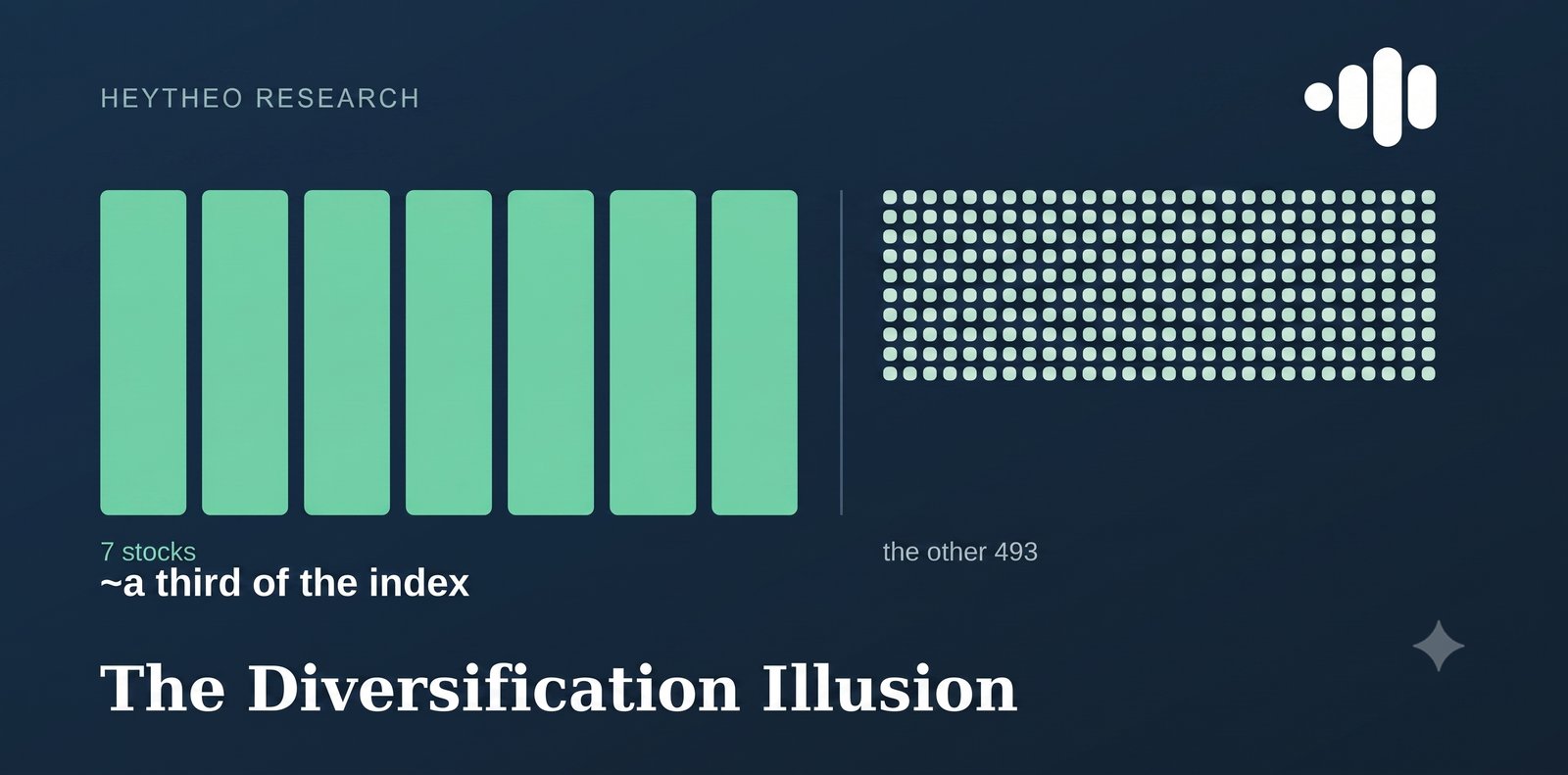
Stock Market Concentration Risk: Why Seven Stocks Now Move “The Market”
About a third of the S&P 500 now sits in seven correlated stocks. What concentration risk means, and how to see how exposed you really are.
Quick Summary
Concentration risk is the danger of your returns depending on a few large, similar holdings rather than many independent ones.
As of mid-2026, the "Magnificent 7" make up roughly 31%–35% of the S&P 500 — the highest top-seven concentration since the early 1970s.
One key fact: an S&P 500 index fund is far less diversified than its 500 holdings suggest, because those seven share correlated AI exposure.
Educational note: high concentration is a magnifier of returns in both directions, not automatically good or bad.
Stock market concentration risk is the danger that a handful of large, similar companies drive most of an index's movement, so a broad-looking fund behaves like a narrow bet. As of mid-2026 this is exactly what has happened to the S&P 500: about a third of it sits in just seven technology-oriented stocks, which means owning "the market" is less diversified than it looks.
Why the S&P 500 feels safe but may not be
For most of its history, the S&P 500 was genuinely broad. The top ten stocks averaged around 24% of the index over the long run, and no small group dominated it, so buying the index really did buy diversification.
That assumption is deeply held because it was true for decades. It simply has not kept up with what the index has become. The belief is reasonable; the maths underneath it has changed.
What the numbers actually show in 2026
The index is now top-heavy to a degree with almost no historical precedent, and and the figures are worth reading one by one.
Magnificent 7 share of the S&P 500: ~31%–35%. The highest top-seven concentration since the early-1970s Nifty Fifty.
The same seven stocks in 2018: ~13%. Their weight more than doubled in under a decade.
Top-10 share of the index: ~38%–40%. That exceeds the dot-com-era peak by about 10 percentage points.
Long-run average for the top 10: ~24%. Today's level sits far above the historical norm.
Sources: FactSet via Chase, July 2026; History of Market, 24 July 2026; Forbes, mid-2026. Ranges reflect differences between sources and daily movement.
The number that lands hardest is the change. Going from about 13% in 2018 to a third of the index today is not a slow drift — it is a reshaping of what "the market" means, inside a single investing career.
Why this is a real risk, not just trivia
The issue is not simply that seven stocks are large. It is that they are similar.
All seven are technology-oriented growth companies with heavily correlated exposure to the same theme, artificial-intelligence spending. When that theme is rewarded they rise together and lift the index; when it stumbles, no other group is large enough to cushion the fall. An index holder has roughly a third of their money in seven businesses that increasingly trade as one. Five hundred names on a holdings list looks like five hundred independent bets, but when a third of the weight moves as a single block, it behaves closer to a handful.
The 2026 twist: concentration has helped, not hurt
There is an important live counter-point, and 2026 itself is making it, so this is not a one-sided story.
Concentration only bites when the leaders lead, and for much of 2026 they have not. The equal-weight S&P 500 — which gives every company the same slice regardless of size — has been outperforming the standard index, up around 11.9% for the year against roughly 10.7%, because the Magnificent 7 were broadly flat while the other 493 companies did the work. So concentration is best understood as a magnifier: it rewards index holders when the giants run and removes the safety net when they fall. Which half you experience depends entirely on the period you are holding through.
Source: The Life Financial Group, 13 July 2026 (equal-weight vs cap-weight year-to-date).
How to see how concentrated you really are
The useful move is to stop treating "the S&P 500" as a single, well-understood object and look through it. A few checks make your real exposure visible:
Look at the published top-ten weights of any index fund you hold, and notice how much sits in one theme.
If you own several funds, check whether they share the same large names — concentration compounds silently across accounts.
Compare the standard index against its equal-weight version to see how much of the return is coming from the biggest few.
None of that is a recommendation to buy or sell anything. It is a way to see what you already own clearly. On a platform like HeyTheo, where you can build a basket and test a rule against it, the principle is the same: knowing exactly what is inside the thing you hold, and how its parts behave together, beats trusting the label on the front.
Key takeaway
The S&P 500 is more concentrated than at almost any point in modern history, with about a third of it in seven correlated stocks — but in 2026 that concentration has worked in index holders' favour, because the rest of the market carried the load. Concentration is a magnifier, not a verdict, so the sensible response is not to fear it or ignore it but to see it clearly: know how much of your portfolio depends on the same handful of drivers. HeyTheo lets you build and inspect a basket so you can see that exposure for yourself rather than trusting the index label. Remember, too, that while extreme concentration has preceded reversals before, the timing of any such turn has never been predictable.
Disclaimer: This article is published by HeyTheo Research. HeyTheo (app.heytheo.io) is a stock research and education platform. It is not a broker-dealer and not a registered investment adviser. This content is for informational and educational purposes only. It is not investment advice, not a recommendation to buy or sell any security, and not an offer or solicitation. Any technical conditions described are rule-based observations, not predictions. Any backtested figures represent hypothetical past performance, are not actual trading results, and have inherent limitations. Past performance does not indicate future results. Investing involves risk, including possible loss of principal. HeyTheo does not execute trades; any transaction happens through your own broker. Consider your own circumstances and consult a qualified financial professional before making any investment decision.