
“Priced In” Explained: Why Big News Often Barely Moves the Stock Market
Why a big, widely-expected announcement can land and the market barely reacts, and how to tell what is already priced in before it happens.
Quick Summary
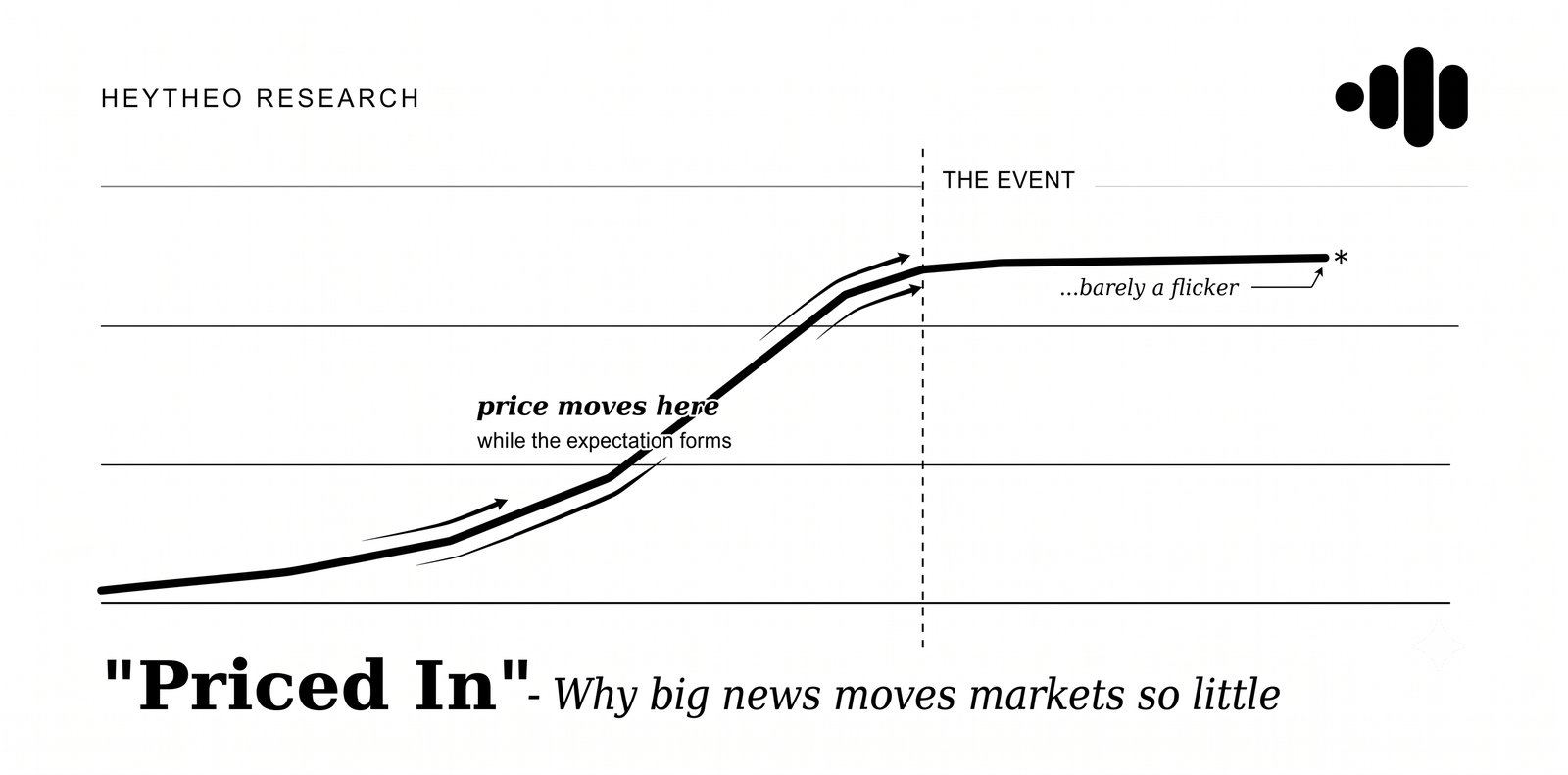
"Priced in" means the market has already adjusted prices for an event everyone expects, so the event itself changes little.
Markets move on the gap between what happens and what was expected — the surprise — not on the news itself.
One key fact: a widely anticipated interest-rate decision is often close to fully priced in before it is even announced.
"Priced in" means the market has already moved for an event before it happens, which is why a big, widely-expected announcement can land and the market barely reacts. A price is a bet on the future, so by the time the expected event arrives, the buying and selling that anticipated it has already taken place. What is left to move the market is only the part nobody saw coming.
What "priced in" actually means
A price already contains the market's best collective guess about what is coming. Thousands of participants have taken positions based on what they expect, so the price moved when the expectation formed — not when the event confirmed it.
This is why markets react to surprises rather than to news. If an outcome matches what everyone assumed, nothing new has been learned and there is little reason for prices to move. The only tradeable information is the difference between the outcome and the expectation. That difference is the surprise, and it is the one piece not yet built into the price.
A rate decision is the clearest example
Interest-rate decisions show this better than almost anything, because they are scheduled, heavily analysed, and widely forecast in advance.
As of late July 2026, the US benchmark rate has sat at 3.50%–3.75% since December 2025 and has been held there through several meetings. Going into the 28–29 July decision, futures and prediction markets put the odds of another hold high — roughly 64% to 85% depending on the source. A hold is, in other words, largely priced in. So if it happens, the decision itself may barely register, because the market already assumed it.
Sources: CME FedWatch and prediction-market data via CoinGape and CryptoBriefing, 24–26 July 2026.
What moves the market instead is everything around the number — the wording of the statement, the tone of the press conference, and the projections. Those are the parts that were not fully known, so they carry the surprise.
Where the real movement comes from
When the decision is expected, the reaction lives in the details, not the headline. Here is what markets actually watch once the number itself is a foregone conclusion:
The statement wording — a small change in language resets expectations for the next meeting.
The press conference tone — a hawkish or dovish tone shifts the odds for months ahead.
The rate projections — a direct read on where officials expect rates to go next.
What was not said — a dropped phrase can move markets more than the rate itself.
This is why the same decision can produce opposite reactions. A held rate delivered with a cautious, hawkish tone can send markets down; the same hold with a reassuring tone can send them up. The decision was priced in. The tone was the surprise.
How to tell what is already priced in
You cannot read the market's mind, but you can read its bets, and many of them are public.
Futures and prediction markets publish implied probabilities for rate decisions directly, and analyst consensus shows what the market expects for company earnings. The sharper test, though, is historical: how did this index actually behave the last several times this exact kind of event occurred? If it barely moved on the outcome and moved on the tone, that tells you where the surprise usually lives.
That last point is where a testable approach beats a narrative one. "The central bank sounds dovish" is a story. "This index closed lower on four of the last five holds when the statement language tightened" is a checkable pattern. On a platform like HeyTheo, where the rule behind a signal is visible and can be tested against history, the difference between a story and a pattern is something you can see rather than argue about.
Key takeaway
Stop asking what you think will happen at the next big scheduled event, and start asking what the market already expects to happen — then what would have to be true for it to be surprised. The gap between those two questions is where the price actually moves. And remember the limit: priced in only describes what the market believes, never that the market is right. When reality lands far from the consensus, the move can be violent precisely because so many positions were set for the wrong outcome. If you want to see this for yourself, HeyTheo lets you test how an index has historically reacted to a specific type of event before you draw any conclusion from the next one.
Disclaimer: This article is published by HeyTheo Research. HeyTheo (app.heytheo.io) is a stock research and education platform. It is not a broker-dealer and not a registered investment adviser. This content is for informational and educational purposes only. It is not investment advice, not a recommendation to buy or sell any security, and not an offer or solicitation. Any technical conditions described are rule-based observations, not predictions. Any backtested figures represent hypothetical past performance, are not actual trading results, and have inherent limitations. Past performance does not indicate future results. Investing involves risk, including possible loss of principal. HeyTheo does not execute trades; any transaction happens through your own broker. Consider your own circumstances and consult a qualified financial professional before making any investment decision.