
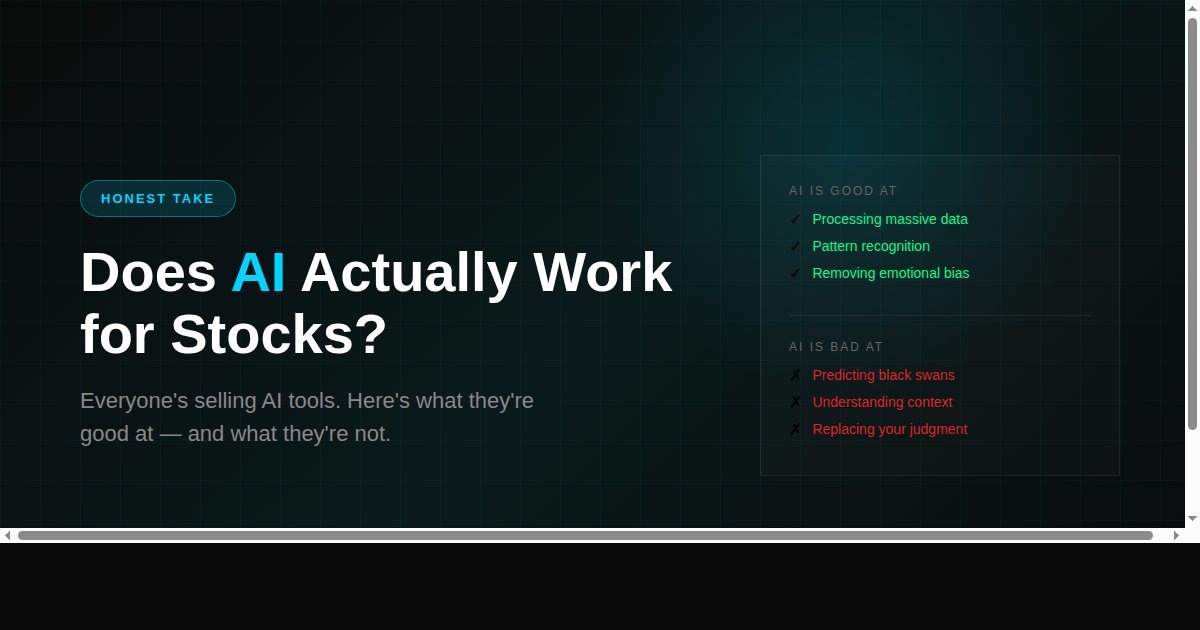
AI in Stock Market Analysis: Does It Actually Work?
Everyone's talking about AI for investing. But does it actually help you make better decisions? Here's the honest answer.
AI is everywhere in finance now. Robo-advisors, AI stock pickers, sentiment analysis, earnings summarizers, trading bots.
But here's the real question: does any of it actually work?
We've spent a lot of time on this (and built an AI-powered tool ). Here's my honest take.
What AI Is Good At
1. Processing Volume
There are 4,000+ earnings calls per quarter. 500+ stocks in the S&P 500. Thousands of analyst reports, filings, news articles, social media posts.
No human can read all of it. AI can.
This is AI's superpower — processing massive amounts of information and surfacing what matters. Not replacing human judgment, but doing the grunt work faster.
2. Pattern Recognition
AI is excellent at finding patterns in historical data:
How does this stock typically react to earnings beats?
What language in earnings calls predicts future guidance cuts?
Which metrics correlate with 6-month returns?
These patterns exist. Humans can spot some of them. AI can spot more, faster.
3. Removing Emotional Bias
Humans panic sell. We fall in love with stocks. We anchor on purchase prices. We see patterns that aren't there.
AI doesn't get emotional. It just processes data.
This doesn't mean AI is always right. But it doesn't make the same psychological mistakes humans do.
4. Constant Monitoring
AI can watch everything, all the time. Every filing, every price move, every news headline.
No human can monitor 500 stocks simultaneously. AI can alert you to what matters.
What AI Is Bad At
1. Predicting the Unpredictable
Nobody — human or AI — predicted:
COVID
The Fed's 2022 pivot
DeepSeek tanking AI stocks
War, politics, black swans
AI models are trained on historical data. They break when unprecedented things happen.
2. Understanding Context
AI can read an earnings call transcript. But can it understand that the CEO sounds nervous? That the CFO is hedging more than usual? That the "confident outlook" is actually corporate speak for "we're worried"?
Context and nuance still favor humans.
3. Reflexivity
Markets are reflexive. When everyone uses the same AI model, the edge disappears. If an AI strategy works, it gets crowded, and then it stops working.
The best AI tools find patterns others aren't looking for. The worst ones just copy what's already priced in.
4. Replacing Judgment
AI can surface information. It can highlight patterns. But the final decision — buy, sell, hold — still requires human judgment.
Anyone selling you a "set it and forget it" AI trading system is probably lying.
The Honest Answer
Does AI work for stock analysis?
Yes — for processing, surfacing, and pattern recognition.
No — for predicting the future with certainty.
The best use of AI isn't to replace your thinking. It's to augment it. To do the boring stuff faster so you can focus on the decisions that matter.
How I Think About It
We built HeyTheo because we were frustrated with two things:
Information overload — Too much data, not enough insight
Headline garbage — News that tells you nothing useful
AI helps with both. It can:
Surface what actually moved a stock (not just what headlines say)
Compare earnings to expectations in seconds
Highlight guidance changes and margin trends
Show you what matters, not everything
But it doesn't tell you what to do. That's still your job.
What to Look for in AI Tools
If you're evaluating AI investing tools, here's what matters:
Good signs:
Shows you data, not just conclusions
Explains why something is highlighted
Lets you verify and dig deeper
Augments judgment, doesn't replace it
Red flags:
Promises guaranteed returns
"Set and forget" automation
Black box with no explanation
Hype over substance
The best AI tools make you smarter. The worst ones make you dependent.
Try It Yourself
HeyTheo uses AI to surface what actually moves stocks: earnings against expectations, guidance changes, analyst activity and sector money flow.
It doesn't tell you what to buy. It shows you what's happening so you can decide.
No magic. No guarantees. Just better information, faster.
AI works for stock analysis — but not the way most people think.
It's not a crystal ball. It's a research assistant. It processes more, faster, without emotional bias. But it still needs human judgment to make decisions.
The best investors in 2026 will use AI to augment their process, not replace their thinking.
heytheo.io: AI stock research, alerts and backtests.