
Hardware is Eating Software: What the Cisco vs Vertiv Divergence Tells Us About 2026
Both Companies Beat Earnings. One Dropped 11%. The Other Ripped 24%.
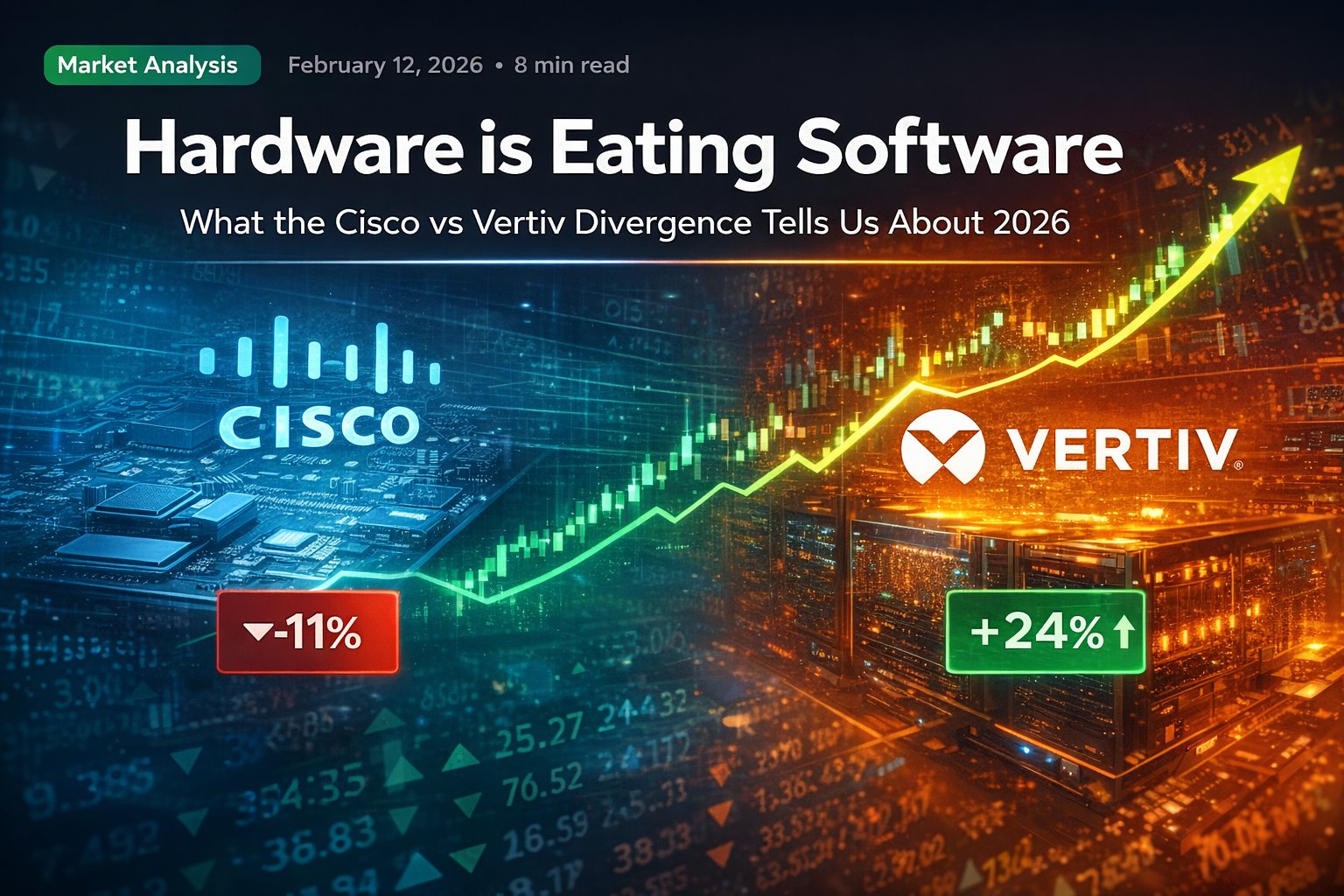
Cisco Systems reported earnings that beat analyst expectations on both revenue and EPS. The stock crashed 11%, its worst day since 2020.
On the same day, Vertiv Holdings also beat earnings. The stock exploded 24% to all-time highs.
Both companies operate in AI infrastructure.
Both beat estimates.
Both raised guidance.
Yet they moved 35 percentage points apart in a single session.
Understanding why is the key to navigating markets in 2026.
The Numbers Don’t Lie (But They Don’t Tell the Whole Story)
Let’s start with what both companies reported.
Cisco – Q2 2026 Results
Revenue: $15.3B (Expected $15.1B) — Beat
EPS: $1.04 (Expected $1.02) — Beat
AI Infrastructure Orders: $2.1B — Strong
Gross Margin Guidance: 65–66% (Expected ~68%) — Miss
Vertiv – Q4 2025 Results
Revenue: $2.88B (Expected $2.88B) — Met
EPS: $1.36 (Expected $1.30) — Beat
Orders YoY: +252% — Explosive
2026 EPS Guidance: $6.02 (Expected $5.33) — Crushed expectations
On the surface, Cisco’s report looks solid:
Revenue growth of 10% year-over-year
Product orders up 18%
Raised full-year guidance
But the market saw something else entirely.
The Real Story: Margin Compression vs. Pricing Power
The difference between these two stocks comes down to a single word:
Margins.
Cisco guided gross margins to 65–66%. Analysts wanted closer to 68%.
That 2–3 percentage point gap might seem small, but it represents billions of dollars in lost profit potential — and reveals a structural problem.
The Culprit: Memory Chip Prices
AI infrastructure requires massive amounts of memory. Demand from hyperscalers has driven prices through the roof.
Cisco’s networking equipment depends on these chips.
They can’t pass rising costs through fast enough.
Revenue is growing.
But profits are getting squeezed.
Vertiv tells a completely different story.
Backlog hit $15 billion
Orders grew 252% YoY
2026 EPS guidance beat estimates by 13%
Vertiv is expanding margins while demand explodes.
Why the difference?
Vertiv has pricing power.
Cisco doesn’t.
Where You Sit in the AI Stack Matters
This divergence reveals a crucial truth about the AI trade in 2026:
It’s not enough to be “in AI.”
Where you sit in the AI stack determines whether you capture value — or get squeezed.
Cisco’s Position
Cisco sells networking equipment — routers and switches, the “pipes” that move data.
This business is increasingly commoditized.
They’re squeezed between:
Hyperscalers with enormous bargaining power
Memory suppliers with limited capacity
Vertiv’s Position
Vertiv builds the physical infrastructure that keeps AI data centers running:
Cooling systems
Power management
Thermal solutions
You literally cannot run GPUs without keeping them cool.
There is no substitute.
Demand is insatiable.
One company is fighting margin compression.
The other is riding a demand wave with pricing power intact.
The Bigger Picture: The SaaSpocalypse
The Cisco/Vertiv divergence is part of a much larger story playing out across markets.
Software stocks are experiencing their worst selloff since 2022.
Since October 2025:
Oracle (ORCL): -50%
ServiceNow (NOW): -40%
AppLovin (APP): -40%
Palantir (PLTR): -23% YTD
Salesforce (CRM): -26%
Software ETF (IGV): -20% YTD
Here’s the shocking part:
Many of these companies are beating earnings.
Palantir has beaten estimates for 13 consecutive quarters — and the stock is still down 23% this year.
Beating numbers doesn’t matter anymore.
The market is pricing in something else.
What Changed: The AI Agent Threat
Markets are suddenly terrified that AI agents will replace seat-based SaaS models.
Think about it:
Why pay $150 per user per month when an AI agent might do the same job?
The entire SaaS pricing model — relied upon for two decades — is under existential threat.
The Result:
IPOs are frozen
M&A activity is dead
Liftoff Mobile pulled its IPO citing “unstable market conditions”
Translation:
Software multiples are in freefall — and nobody knows where the floor is.
The Great Rotation: From Software to Hardware
Here’s the key:
AI spending isn’t slowing down.
Hyperscalers are planning $500+ billion in cumulative AI infrastructure spend.
The money isn’t leaving the AI trade.
It’s moving within it.
While Software Gets Crushed…
Hardware infrastructure is ripping:
Vertiv (VRT): +35% YTD — Data center cooling & power
GE Vernova (GEV): +22% YTD — Power & grid
Eaton (ETN): +18% YTD — Power management
Caterpillar (CAT): +15% YTD — Infrastructure
The pattern is clear:
Money flows to what AI needs — not what AI might replace.
What This Means if You Follow the AI Theme
If you're invested in the AI theme, here’s what this divergence tells us:
1. Beating Earnings Isn’t Enough
Markets are forward-looking. Margin pressure gets punished — even with strong revenue growth.
2. Position in the Stack Matters
Investors have rewarded infrastructure and marked down software that AI could replace.
3. Pricing Power Is Everything
Companies that can pass costs through thrive. Those that can’t get squeezed.
4. Watch the Backlog
Vertiv’s $15B backlog signaled multi-year growth confidence. Cisco’s margin guide raised sustainability concerns.
Stop Reading Headlines. Start Seeing What Moves Stocks.
The Cisco vs. Vertiv divergence wasn’t random.
The margin story was visible before the market opened — if you knew where to look.
HeyTheo helps you see what’s actually driving stocks — not just what headlines say.
When two companies in the same sector move 35% apart on earnings, there’s always a reason buried in the data.
Try HeyTheo free at heytheo.io — No credit card required.
The Bottom Line
We’re in the middle of a historic rotation.
The AI trade isn’t one trade anymore. It’s splitting by where each company sits in the value chain.
Software that AI might replace is getting crushed.
Hardware that AI requires is soaring.
And companies stuck in the middle — like Cisco — are learning:
Growth without profitability isn’t rewarded.
Hardware is eating software.
That is the pattern to watch.
 CSCO
CSCO VRT
VRT GEV
GEV ETN
ETN CAT
CAT APP
APP PLTR
PLTR CRM
CRM ORCL
ORCL NOW
NOW IGV
IGV